
Alamelu – A Leader Changing her Community
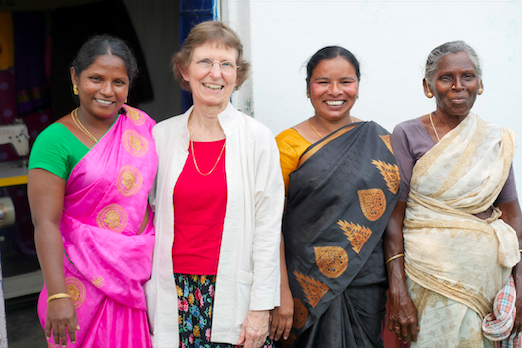
Alamelu runs a nongovernmental organization (NGO) in Tamil Nadu, India. Her NGO received training and a grant from Right Sharing in 2022.
Alamelu was born to a poor family in the Arunthathiyar caste. Her home was a simple hut, and her parents were bonded laborers on a farm. Bonded labor, although illegal in India, continues to impact millions every year. Often referred to as “modern day slavery”, individuals are forced to work to repay a loan or a debt in abusive conditions. The wages her parents received were very low, allowing them to eat only grains such as millet.
When Alamelu was a child, her parents fell ill with smallpox and were unable to work while they were sick. The farm owner brought Alamelu and her brother to work at the farm in their absence, forcing the children into bonded labor. At the farm they were exploited, punished, and treated cruelly.
At school, Alamelu’s teacher, Mr. Vengadasalam, noticing that she had been absent for a long time, came to her home to check on her. When her parents told him about the situation, he went to the farm to find her. When he approached the farm owners to ask that they release the children, he was severely beaten. After this incident, the teacher returned with the local police and paid the family’s debt to the farm owners – releasing them from bondage.
Alamelu returned home and resumed her education. Mr. Vengadasalam motivated her to study and be of service to her community. Her childhood experiences and her teacher’s support inspired her to start the NGO, the Rural Women’s Development Trust (RWDT), and work to uplift her community. With a Bachelor’s degree in Commerce and certification in Cooperative Training, she fights against the bonded labor system and has released many families from this type of exploitation. Having dedicated her life to the underprivileged, she has been doing development work since 1998. Alamelu has received recognition among underprivileged communities as well as from government departments as a women activist and worker for women’s rights and development. In addition to her work with the RWDT, she is a fulltime social worker. She has devoted her life to ending bonded labor – a practice that has been forced on her caste.
Alamelu works against such injustices as untouchability, the double tumbler system (at tea stalls, people of the Dalit caste are served out of different and lower-quality cups), and female infanticide. Her work has been unpopular with people who benefit from the current social order. They have tried to attack her many times. A gang of men arrived to attack her at her house when she wasn’t home, so they severely attacked her brother instead. He was admitted to a hospital, where he died. The grief from this event impacted her and compelled her to work even more against social injustice.
Rural Women Development Trust works with underprivileged women, forming self-help groups, encouraging savings, and helping them establish bank linkages. They work to free child laborers, bonded laborers, and manual scavengers, and help them to establish new sources of livelihood. They also offer human rights and health education.
RWDT has strategic goals for the future, including the following:
- Providing self-employment skill training to 2,000 formerly bonded and vulnerable women.
- Offering quality education for 3,000 children via 50 child resource centers.
- Building civil society organizations for collective action on Arunthathiyar development.
- Ensuring environmental justice and land, water sanitation, and health accessibility for underprivileged communities in the target area.
On a visit to India, Alamelu met with Jackie Stillwell, Right Sharing’s former General Secretary. “Right Sharing is not dictating how Alamelu works…,” said Jackie “… she is the driving force, and her power has linked Right Sharing with 200 women’s groups. She is on fire to connect with and train women to help each other and help themselves. Alamelu has gathered hundreds of women and gotten the government to set aside land on which they could build houses.”
Alamelu is a force for change in her community and is nurturing that force through collective action. Alamelu says of RWDT: “To further the financial sustainability of our efforts, the women rescued from bonded labor have received skill training and income generating resources. This means a sustained income for the women and their families. The women have become decision-makers in their families and participate in public events.”